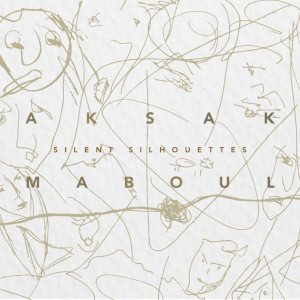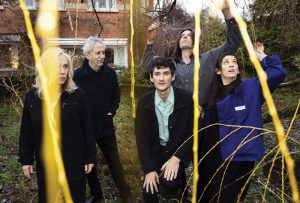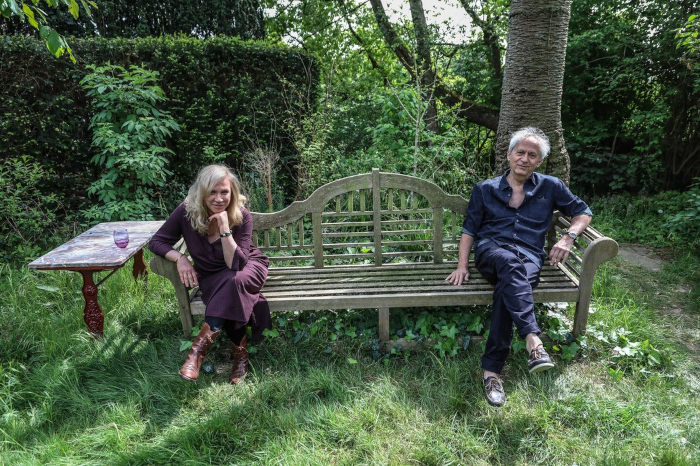
There’s exciting news from legendary experimental pop group Aksak Maboul, who have a new album on the way. Entitled Fifteen Ways of Looking at It, it’s due in early 2027 through Crammed Discs, and follows 2023’s Une aventure de VV (Songspiel) and 2020’s Figures, which ended a 40-year recording hiatus. With a greater emphasis on instrumental and abstract excursions, the upcoming album finds founder Marc Hollander returning to the sound of Figures. Written and arranged by Hollander, Fifteen Ways of Looking at It brings together an impressive cast of collaborators, including guitarist Fred Frith, drummer-in-demand Tom Skinner, Stereolab’s Laetitia Sadier, members of Tuxedomoon and Aquaserge, and Nihiloxica’s Spooky-J, alongside Aksak Maboul regulars Lucien Fraipont and Faustine Hollander. Across fifteen tracks and three interludes, the music ranges from electronica, pop and jazz to sound collage, krautrock, ambient and contemporary classical.
The album also has a special and poignant significance as the last to feature Véronique Vincent’s poetry and unique vocals, which have been an integral part of the group’s work in recent years. Vincent, Hollander’s longtime creative partner, completed her writing and recording for the album in the summer of 2025, shortly before her death in October that year.
Aksak Maboul are offering a dazzling glimpse of what’s to come with ‘Montagne’, written and performed by Hollander and Vincent. Inspired by an alphorn melody, Vincent’s lyrics use the image of a mountain being climbed, conquered and eventually reduced to dust as a metaphor for masculine domination. As Hollander explains in the album’s liner notes, the lyrics leave room for two opposing interpretations:
“This alphorn melody made me think of a majestic mountain landscape. Véronique’s imagination was fired by this idea, she wrote a text, originally subtitled “Lettre à un salopard” (“Letter to a Bastard”), in which a mountain is climbed, conquered, and finally reduced to a pile of dust. She said the story was a metaphor for masculine domination (somewhat like Le Mur, in our previous album). It now occurs to me that the lyrics can work in more than one way: does the mountain represent an oppressive man, eventually defeated by a woman? Or is this the tale of a woman being ruthlessly annihilated by a man? Maybe Véronique had both interpretations in mind, but we can’t ask her.”
‘Montagne’ comes with an accompanying video directed by Yoann Stehr & Izia Pinkman, and you can watch it below.